El 15% de los empleados falla en una simulación de phishing estándar. Si se añade una llamada de vishing que hace referencia a ese correo electrónico, la tasa de error asciende al 87,5%.
El segundo número no es el problema. El problema es que la mayoría de los programas de concienciación sobre seguridad solo miden el primero.
Los ataques coordinados que secuencian múltiples canales —phishing, vishing, confirmación por chat— no son una tendencia emergente. Son el estándar operativo actual para cualquier campaña dirigida. Y el modelo de simulación sobre el que se basa la mayoría de la formación en seguridad no fue diseñado para replicarlos.
La brecha entre cómo sus simulaciones ponen a prueba el criterio de los empleados y cómo los ataques coordinados llegan realmente a ellos es donde los datos de preparación dejan de ser fiables. Entender esa brecha no requiere reemplazar su programa actual. Requiere ser preciso sobre lo que su programa actual puede y no puede medir.
El ataque que comienza de forma inofensiva
Un ataque multivectorial no comienza con la solicitud más peligrosa. Comienza con la más creíble.
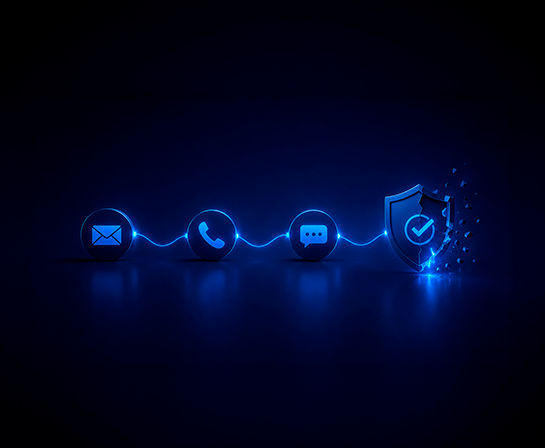
Una secuencia típica es así: llega un correo de phishing desde una dirección que parece pertenecer a un proveedor de confianza. El correo solicita la confirmación de los detalles de una factura; nada inusual. Dos horas después, una llamada telefónica hace referencia al correo por su nombre y contenido. La voz al otro lado explica que hay un plazo de procesamiento. Un mensaje de seguimiento llega a través de Teams o Slack, desde un perfil que parece pertenecer a un compañero de TI, confirmando la urgencia.
En cada etapa, el ataque utiliza el punto de contacto anterior para establecer credibilidad para el siguiente. El correo de phishing prepara al empleado para esperar la llamada. La llamada valida el correo. El mensaje de chat confirma ambos. Para cuando llega el tercer punto de contacto, el empleado ya no está evaluando una amenaza, sino completando un proceso que comenzó dos pasos atrás.
Esta estrategia de secuenciación no es nueva. Lo que ha cambiado es la facilidad y la escala con la que se puede implementar.
Los ataques de vishing aumentaron un 442% entre el primer y el segundo semestre de 2024. (Keepnet Labs, 2025) El spear phishing impulsado por IA logra ahora una tasa de clics del 54% en pruebas controladas, en comparación con el 12% de las campañas tradicionales. (Brightside AI, 2025) El coste de coordinación que antes hacía que los ataques multivectoriales fueran operativamente complejos ha desaparecido en gran medida.
Lo que su tasa de clics no le está diciendo
Las pruebas estándar de simulación de phishing evalúan una única capacidad: ¿puede este empleado identificar un correo electrónico sospechoso cuando llega de forma aislada, sin presión social y sin contexto previo?
Es una capacidad útil que desarrollar, pero no es la única que importa bajo condiciones de ataque coordinado.
La investigación de Zepo Intelligence reveló que el phishing por sí solo produjo una tasa de error del 15 % entre las poblaciones de empleados evaluadas. Cuando el mismo correo de phishing fue seguido por una llamada de vishing generada por IA que hacía referencia a él, la tasa de error aumentó al 87,5 %: un incremento de seis veces al añadir un solo canal adicional.
Los empleados que fallaron en el escenario combinado no estaban menos informados que aquellos que tuvieron éxito en la prueba de vector único. Estaban expuestos a un tipo de presión diferente: la credibilidad acumulada de una secuencia que ya empezaba a parecer legítima antes de que llegara la solicitud más peligrosa.
La simulación de vector único no puede generar datos de preparación para ese escenario porque evalúa una condición cognitiva fundamentalmente distinta. El empleado en una simulación de phishing estándar evalúa un único punto de datos. El empleado en un escenario multivectorial gestiona un proceso en el que cree que ya está participando.
La IA eliminó las señales que enseñó a detectar
El contenido generado por IA ha eliminado las señales superficiales que la formación de vector único estaba diseñada originalmente para detectar.
La formación tradicional en detección de phishing enseñaba a los empleados a buscar errores gramaticales, saludos genéricos y direcciones de remitente que no coincidían. Los correos de phishing generados por IA producen ahora contenido gramaticalmente impecable, con un tono adecuado y contextualmente específico para el destinatario. El 82,6 % de los correos de phishing en 2025 contenían contenido generado por IA.
Más importante aún, la IA ha permitido a los atacantes personalizar secuencias multivectoriales a gran escala. Una voz clonada a partir de tres segundos de audio público puede utilizarse en una llamada de vishing que suena exactamente igual a la del gerente del empleado. Un correo de phishing puede redactarse con el estilo de un proveedor con el que la organización lleva años manteniendo correspondencia.
Las señales que la formación de vector único preparaba a los empleados para reconocer se han reducido sistemáticamente. Lo que queda es una decisión basada en el proceso y el protocolo: el tipo de criterio que se desarrolla mediante la exposición a escenarios coordinados, no mediante el reconocimiento aislado de plantillas.
Estás midiendo lo correcto en las condiciones equivocadas
El problema fundamental de la simulación de vector único no es que evalúe la habilidad incorrecta. Es que evalúa la habilidad correcta en las condiciones equivocadas y utiliza los resultados para extraer conclusiones sobre un conjunto de condiciones diferente.
La tasa de clics mide si un empleado puede identificar una señal de ataque de forma aislada. Esa es una medición distinta a cómo se mantiene el criterio de un empleado cuando ya ha sido condicionado por un punto de contacto previo, bajo presión de tiempo y con una solicitud que parece provenir de múltiples fuentes creíbles simultáneamente.
Las organizaciones que optimizan sus programas de seguridad en torno a la reducción de la tasa de clics están mejorando una métrica con un valor predictivo limitado para los incidentes que ahora son más importantes. No porque la tasa de clics sea irrelevante —es un indicador adelantado razonable—, sino porque fue diseñada para un entorno de amenazas donde los ataques llegaban como eventos únicos en lugar de secuencias coordinadas.
La unidad de medida correcta no es "¿hizo clic el empleado en este correo?", sino "¿cómo se mantiene el criterio de este empleado cuando ya ha sido condicionado por un punto de contacto previo?". Estas son capacidades diferentes y requieren pruebas distintas para salir a la luz.
Tres preguntas que probablemente su programa actual no puede responder
Para los líderes de seguridad que evalúan sus programas actuales, la realidad multivectorial apunta a algunas preguntas específicas que vale la pena analizar.
La primera es si el diseño de su simulación refleja cómo llegan realmente los ataques. Una biblioteca de simulación construida a partir de plantillas genéricas de un solo canal evalúa el reconocimiento de señales que el contenido generado por IA está diseñado específicamente para eliminar. Las simulaciones creadas a partir de patrones de ataque reales —incluidas las secuencias reales detectadas contra su organización— producen datos de comportamiento más relevantes.
La segunda es si su marco de medición captura el criterio bajo presión combinada. Las tasas de clics agregadas promedian a la población y ocultan los roles, equipos y contextos de flujo de trabajo específicos donde es más probable que la presión de un ataque secuenciado tenga éxito. El perfilado de comportamiento a un nivel más granular identifica dónde se concentra realmente la exposición organizacional, antes de que un atacante la encuentre.
El tercer punto es si su programa se adapta de forma continua. Una biblioteca de simulación que refleja lo que hacían los atacantes el año pasado no es lo mismo que una que refleja lo que está atacando a su organización esta semana. La conexión entre lo que detecta su puerta de enlace y lo que aborda su formación es la cuestión de infraestructura que determina si sus datos de preparación se mantienen actualizados o quedan obsoletos.
Conclusión
Los ataques multivectoriales no son un fenómeno nuevo. La estrategia de secuenciación ha sido una característica de la ingeniería social sofisticada durante décadas. Lo que ha cambiado es que la IA ha hecho que esta estrategia sea operativamente accesible a una escala que antes requería importantes recursos y planificación.
Los programas de concienciación sobre seguridad que ejecutan la mayoría de las organizaciones no fueron diseñados para esto. No es una crítica. Fueron diseñados para un entorno de amenazas diferente y muchos de sus elementos siguen siendo válidos. La brecha que merece la pena cerrar es específica: la metodología de pruebas que sustenta la mayoría de los programas mide una capacidad de canal único y la utiliza para sacar conclusiones sobre la preparación de la organización ante la presión multicanal.
Cerrar esa brecha requiere que dos cosas trabajen juntas. En primer lugar, simulaciones que repliquen la secuencia real de cómo se producen los ataques coordinados —a través de correo electrónico, voz y chat—, no solo en un canal de forma aislada. En segundo lugar, una conexión directa entre lo que ve su capa de detección y lo que ejecuta su programa de formación. Cuando esos dos sistemas comparten datos, cada ataque real dirigido a su organización se convierte en información para la siguiente simulación. La preparación deja de ser un ejercicio de calendario y se convierte en una respuesta continua al entorno de amenazas tal y como existe realmente.
La pregunta en torno a la cual se construyen la mayoría de los programas de seguridad es si los empleados pueden detectar un correo electrónico sospechoso.
La pregunta que importa es si su criterio se mantiene cuando el ataque ya lleva dos pasos en marcha.


.png)
.png)
.png)

.png)
