- More than 60% of security breaches in 2025 still involve a human factor, and most organizations operate with separate systems that never share what they know.
- Zepo Intelligence launches the first platform where real threat intelligence and security training share a single data model, turning every blocked attack into an asset.
Madrid, April 13, 2026 — Zepo Intelligence is now the first cybersecurity ecosystem for human risk: a platform where real-time threat detection and secure behavior training share a single platform. With over 60% of security breaches caused by the human factor, the company has taken a decisive step to become the only operator capable of addressing threats in a unified way.
Every organization running a security gateway and a training platform in parallel generates two bodies of intelligence that never meet. The gateway sees which attacks are targeting its employees, in real time, across all channels. The training platform sees how those employees respond to simulations, over time, by role and behavior. The intelligence that should emerge from connecting them — who is most vulnerable to the specific attacks targeting the organization today — exists in neither system.
That gap is the human risk blind spot. It is where attackers aim.
Zepo Intelligence today presents the first cybersecurity ecosystem that solves it, now available to the company's clients.
Connected, not siloed
The cybersecurity industry is not short on capability. Major vendors have sophisticated products for both attack detection and employee training. But gateway technologies were designed to protect channels. Training platforms were designed to inform and educate employees. Neither was designed to share a data model.
Connecting them through APIs and dashboards produces reports. Not a system that learns and acts. Every existing platform stops there, at the report. Someone has to interpret it, decide what to do, and execute it manually.
The result: platforms generating siloed data. CISOs alone in front of dashboards, deciding what to do with it. Organizations using an average of 45 cybersecurity tools still cannot answer the most basic question in human risk management: who are the people most vulnerable to the specific attacks arriving today.
"Security teams are not missing data. The architecture is the problem. The gateway and the training platform each generate valuable intelligence in isolation, but they never talk to each other. That disconnect is not an implementation failure: it is a structural limitation of how the entire category has been built. Zepo is the answer to that limitation." Antonio Muñoz, CEO of Zepo Intelligence
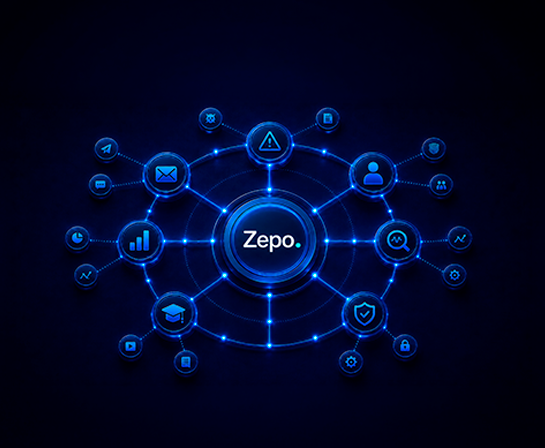
Zepo Intelligence, with its unique data model, has built a system that operates in real time. Every blocked threat immediately informs which simulation and which training the affected employee receives. Every behavioral signal continuously refines how protection is applied. The result is a risk profile that becomes more precise and more defensible over time, without manual intervention at every step.
Three actions for security leaders
- A unified intelligence ecosystem. Real attacks automatically trigger the right simulation and training, not generic templates scheduled months in advance. Behavioral results feed back into policies, controls, and prevention without manual intervention. A single system integrated across the entire stack.
- Precision simulations and training. Hyper-personalized by role, risk pattern, and individual behavior. Built from the attacks that have targeted that organization, not from a static library. The cycle is measurable: real threat → simulation → training → demonstrable behavior change.
- A strategy defensible to any audience. Risk levels and trends by team, department, and time period. Evidence for regulatory compliance, audits, and board reporting — built from the same data that drives the program, not from a parallel report.
"When threat detection and human risk prevention share the same data model, the security program stops being a collection of tools and becomes a closed loop that learns over time. It learns which combinations of role, threat exposure, and behavior pattern predict incidents in that specific environment — and acts on that intelligence automatically. That is not a feature. It is what an ecosystem does that a platform cannot." Antonio Muñoz, CEO of Zepo Intelligence
No competitor today offers a platform where a security gateway and behavior training share a native data model. The most advanced attempts in the market produce correlated reports between separate systems. Correlation is not a closed loop. The intelligence generated by blocking an attack still does not automatically become the context for the next training intervention. Zepo is the first platform where this conversion happens natively, continuously, and without manual intervention.
About Zepo Intelligence
Zepo Intelligence is the first cybersecurity ecosystem for human risk. The only platform where real-time threat detection and human risk prevention share a data model, so that every blocked threat reinforces training, and every behavior change reinforces protection. Present in Spain, Latin America, and the United States, Zepo works with organizations that need to stop managing tools separately and start operating a program that learns on its own.


.png)
.png)
.png)

.png)
