What the reports establish and what they leave open
The chief executive wrote nothing, according to Forbes Italia, and the lawyer knew nothing of the transactions, according to Confilegal. Both were impersonated. According to Reuters' sources, neither the chairman nor other executives of the bank are under investigation (Reuters via Deccan Chronicle, September 26, 2026).
The bank noticed irregularities quickly and alerted banks and authorities in several countries. Reuters reports that more than half of the money was recovered through cooperation among authorities in China, Portugal and Italy. About €36 million is unaccounted for, and Reuters' sources say it passed through overseas accounts and was converted to cryptocurrency.
Confilegal adds that Eurojust coordinated with Lisbon prosecutors, and that Milan prosecutors had €13 million blocked at a Portuguese bank (Confilegal, September 29, 2026). One of Reuters' sources said Milan prosecutors are investigating a foreign national living outside Europe for suspected computer fraud. The bank declined to comment.
Most details come from unnamed sources and press reports. The voice-cloning claim is attributed to those sources and has not been confirmed publicly. We treat the case as reported, not proven.
The case is not isolated. ANSA reported that prosecutors are examining similar cases, including an identical scam against a company in another Italian banking group (ANSA, cited by Cybernews, September 27, 2026). Reuters also recalls that a cloned minister's voice persuaded a businessman to transfer nearly €1 million in 2025. The money was later recovered.
What a multichannel attack is, and why this case qualifies
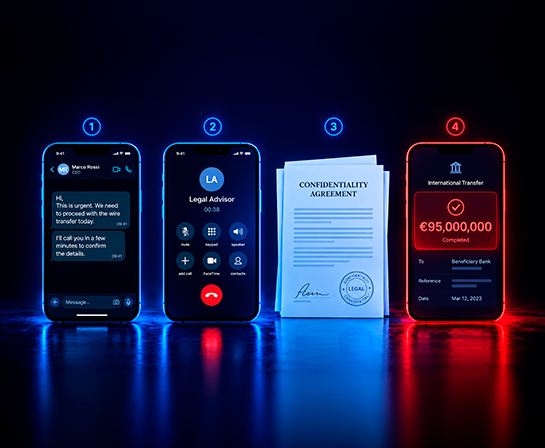
A multichannel attack, which we also call a multiattack, reaches a target through two or more channels in sequence, such as a message, a call and documents. Each step is designed to make the next one more believable.
This case has at least two confirmed channels: a WhatsApp message and a phone call. The 11 documents are a third element, although the reports do not say how they arrived. What matters is the design. The message opened the door, the call confirmed it, and the documents gave the request a legal shape.
The FBI described the same design in a different setting in May 2026. An email or text asks an employee to call a number. A caller posing as IT support asks for a remote session, and if that fails, someone visits the office with a USB drive (FBI FLASH-20260526-01, May 26, 2026). A bank in Milan and a group that targets mainly US law firms follow one design: a first contact earns a second, and the second earns access.
Trust moved from person to person, and no stranger appeared
Many detection cues depend on something being unfamiliar: an unknown sender, an odd address, an unexpected link. This sequence offered none of them.
Every step borrowed trust that already existed. The first message borrowed the authority of the group's chief executive. The call borrowed a personal relationship and a voice the chairman recognized, according to Confilegal. The documents borrowed institutional process, because a confidentiality agreement and a power of attorney look like what real deals require.
The story also explained its own secrecy. Confilegal reports that the chairman was asked to route the transfers through the private banking arm's treasury because the parent bank could not execute them itself. A confidentiality agreement made silence sound professional. Both details gave a reason to skip the normal route.
We read this as the core design of a multiattack. The attacker borrows trust the target already has, one step at a time, instead of earning new trust from a stranger.
Why verifying inside the sequence fails
A common reaction to a doubtful message is to call and confirm. In this case, the call was the confirmation. A reply in the same thread, or a call to a number supplied by the requester, confirms the attacker.
AI lowers the cost of that step. The FBI's IC3 received 22,364 complaints in 2025 that reported AI-related information, with adjusted losses above $893 million. Businesses reported more than $30 million in losses to business email compromise scams involving AI (FBI IC3, 2025 Internet Crime Report, April 2026).
ENISA notes that AI-supported phishing campaigns reportedly accounted for more than 80% of observed social engineering activity worldwide by early 2025 (ENISA, October 1, 2025).
The FBI's figures also show how costly persuasion-led fraud is. It logged 24,768 business email compromise complaints with $3.05 billion in losses, against 191,561 phishing and spoofing complaints with about $216 million. By our calculation, that is one-eighth of the complaints and roughly 14 times the losses. The categories are counted separately, so the comparison is indicative.
What changes for security teams
We recommend treating the shape of the request as the trigger, not the credibility of the sender. A request that combines urgency, secrecy and an unusual route should start a verification every time. In this case, asking a private banking unit to move funds through its treasury because the parent could not execute them was the anomaly.
Verification should run through the directory, not the thread. The employee confirms through a contact they find themselves, such as the internal directory, and never through the number or message that delivered the request.
Approval needs a second person outside the requester's chain. A request that appears to come from the top of the hierarchy is where a single approver is most exposed. A second approver turns one convincing story into two independent decisions.
Reporting speed also matters. The bank noticed irregularities quickly and alerted banks and authorities in several countries, and more than half of the money was recovered (Reuters via Deccan Chronicle, September 26, 2026). Reporting within minutes is a skill, and people practice it only when reporting feels safe.
Finally, teams need to test the whole sequence. A simulation that measures one click measures one skill. At Zepo, we built our Multiattack Simulations to test how people respond to a full sequence, from the first message to the call that confirms it. A useful rehearsal asks who verified, through which channel, and how quickly they reported.
The reports describe no exploit and no malware. They describe a believable story, told in the right order, by voices the target trusted. Organizations that train people to verify the request, and that rehearse the full sequence, prepare them for an attack where nothing looks unfamiliar.
FAQ
What is a multichannel attack? A multichannel attack reaches a target through two or more channels in sequence, such as a message, a call and documents. Each step makes the next one more believable. Zepo also calls this pattern a multiattack. Email filters, call controls and document checks each see only one fragment.
What is a real example of a multichannel attack? In February 2026, the chairman of an Italian bank's private banking arm received a WhatsApp message appearing to come from the group's chief executive. A call followed from a voice reportedly cloned from a lawyer he knew. Transfers of about €95 million followed. Reuters reports that more than half was recovered and about €36 million remains unaccounted for.
Was that case phishing? It depends on the definition. ENISA groups vishing and other message-based attacks under phishing, and the case began with a message impersonating a trusted person. The press calls it CEO fraud, and the FBI tracks business email compromise separately. We describe it as a multichannel attack that includes phishing and vishing.
How was the voice cloned? The reports do not describe the tools or the method. Reuters, citing two sources familiar with the matter, says AI was used to replicate the lawyer's voice. The bank declined to comment, so the technical details remain unconfirmed.
How can companies defend against a multichannel attack? Treat urgency, secrecy and an unusual route as a trigger for verification. Confirm through a contact found in the internal directory, not in the message. Require a second approver outside the requester's chain. Make reporting fast and safe, and rehearse the whole sequence, not only the first message.