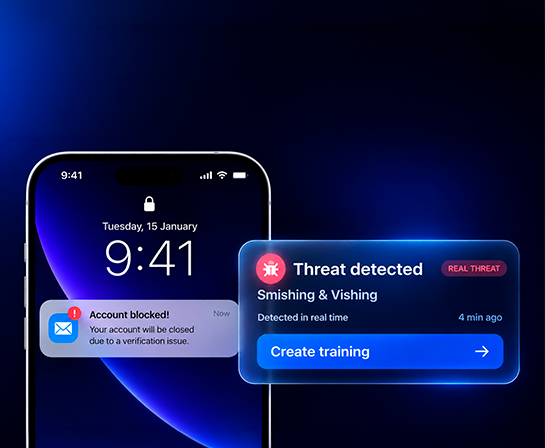
A signal is only useful for training if it keeps its context
Detection can produce data about a suspicious message, an alert or an impersonation attempt. To decide what to do with it, keep the provenance, the channel, the date, the threat type, the verdict and the identity of the recipient when it is known. A blocked event, a delivered message and an observed interaction do not describe the same thing.
Linking the event to a person requires a consistent reference across systems. An email address helps, but name changes, aliases, shared accounts and leavers complicate the match. Before activating an individual intervention, define what to do when the identity does not resolve with enough confidence, for example by keeping the event unassigned and sending it for review.
The profile must distinguish exposure, observed behavior and training results. Receiving many phishing attempts indicates exposure. It does not show that a person clicked or is responsible for an incident. An aggregated score helps prioritize if it lets you understand which information feeds it and what could not be observed.
Four types of signal connect the stages of the cycle
The four types are real detection, observed behavior, simulation, and training with its follow-up. Each answers a different question, and the cycle only works if the system keeps them separate.
Data can come from an integrated platform or from several connected systems, and in both cases you must keep the provenance and the type of each event. A simulated click is not a click on a real threat. The absence of a report does not prove that a message was ignored either, if we do not know whether it was delivered or whether the person saw it.
From event to intervention: an illustrative example
The following path is fictional. It describes one possible architecture, not a specific Zepo configuration or integration.
- Detection. An email tool identifies a message impersonating a supplier and records that it was blocked before delivery. The event keeps its origin, time, channel and verdict.
- Identity and context. The system links the recipient to an employee identifier from the directory. The record reflects exposure to a blocked attempt, without attributing a click.
- Decision. A rule defined by the security team proposes a short lesson on verifying changes to bank details. The organization decides whether it is assigned automatically or needs review.
- Intervention. The assignment is recorded and, if it happens, so is completion. Later, the team can plan a related simulation, identified as an exercise and not as an incident.
- Follow-up. In a later simulation, the system records whether the message was delivered, whether it was reported and what other response could be observed. The team compares results with a test of similar difficulty and audience, without concluding that a single intervention caused the change.
If the event arrives late, the identity does not match or the rule does not run, the path must show it. A dashboard that shows the threat and a training course on the same screen does not show by itself that one triggered the other.
Integrations must let you follow the event end to end
In a technical evaluation, ask the vendor to show what happens at each exchange point:
- Threat source: which tools and channels can provide signals, which fields arrive and how often. Distinguish alerts detected by the platform itself from those imported from a third party.
- Identity: which identifier joins directory, detection and training, and how aliases, shared accounts, changes and leavers are handled.
- Rules and intervention: which events can trigger an action, who configures the conditions and when human approval is needed. Ask what happens with duplicates, false alarms and corrected events.
- Training and simulations: how the assignment is recorded and which results return to the profile. If an external LMS exists, check both the sending and the receiving of the completion status.
- Audit and failures: how the origin of the event, the decision, the action and its result can be queried, and how errors, delays or an interrupted integration are detected.
An API, an export or a connector can be part of the solution, but their availability does not show that all events, fields or actions are supported. Ask for documentation and a test with the tools and permissions of your environment.
Measuring the cycle requires separating activity, behavior and exposure
Training completion tells you whether an activity was completed. It does not show by itself that the person will recognize a threat. To evaluate the path, look at several layers:
- Workflow operation: events received and correctly matched, interventions assigned and failed, and time between the signal and the action. Define the start and end clock for each measure.
- Response in simulations: proportion of delivered messages that are reported and proportion with a recorded interaction, with their denominator and time window.
- Real exposure: volume and type of threats detected, taking into account changes in coverage, sources and detection rules.
- Trend: follow the same cohort when possible, with comparable scenarios and an explanation of changes in audience or difficulty.
The formulas for rates and medians are in our guide to measuring phishing behavior. To decide what support to assign for each signal, use the signals matrix for prioritizing training.
The NIST Phish Scale user guide, published in November 2023, proposes a method to rate how hard phishing emails are for people to detect. That difficulty matters when comparing exercises: a change in clicks can reflect a different scenario and not a change in behavior. The guide focuses on email, and simulation results do not equal avoided incidents either.
What to check in a demo
Ask the vendor to walk through one case from start to finish with test data:
- What signal does the system receive, which source does it come from and how is it told apart from a simulation?
- How is it linked to the employee and what happens if the identity is ambiguous?
- What condition decides the intervention and who can change or approve it?
- Can you see whether the action was assigned, failed or is pending?
- Which results return to the profile and with what latency? Is the evidence of the path kept?
- What permissions, personal data and retention periods does each integration need?
- How are records exported for review and what happens if a false positive is corrected?
To protect people, agree with the privacy and security leads which data is necessary, who can see individual results and how long they are kept. The evaluation must check those decisions in the specific configuration, without assuming that all systems offer the same controls. Involve privacy, legal counsel and HR before activating individual interventions.
How we approach the cycle at Zepo
At Zepo we connect detection signals, simulations, training and human risk analytics. On our homepage we describe how signals from real attacks can feed simulations and adaptive training. The channels, integrations, fields, trigger conditions and timings available to a specific organization are checked with our product team during the evaluation.
If you want to review the architecture before a demo, the article on the gap between the gateway and training poses four diagnostic questions.